
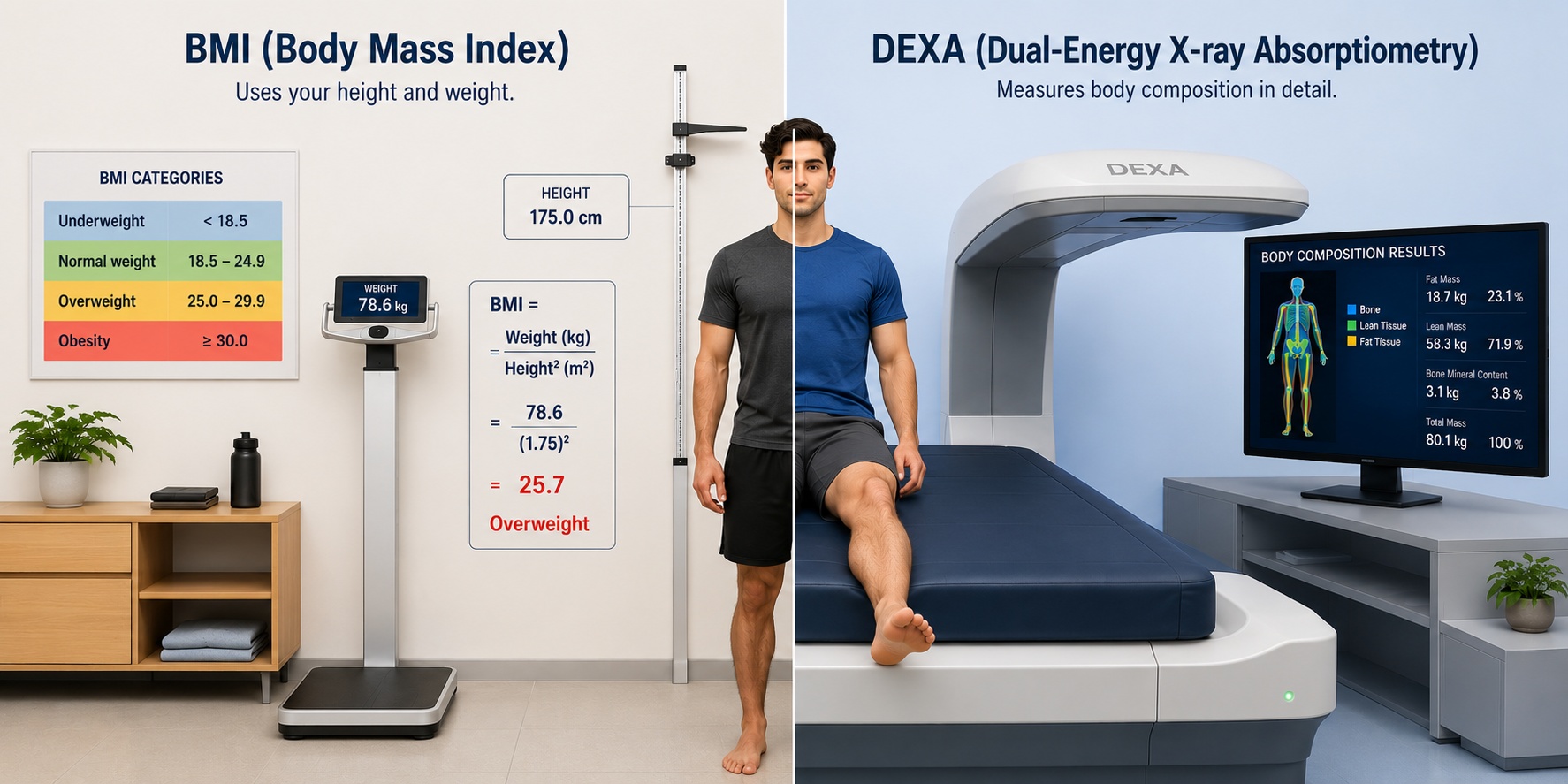
For many years, stepping onto a set of scales and calculating Body Mass Index (BMI) have been the traditional ways people assess whether they are considered a healthy weight.
BMI has become one of the most recognised health measurements in the world. It appears in medical records, health assessments, research studies and everyday conversations about weight. It provides a simple calculation based on two easy-to-measure factors: height and weight.
For large-scale health research, BMI has been incredibly useful.
However, when it comes to understanding an individual’s health, fitness, and physical condition, BMI only tells part of the story.
The human body is far more complex than a single number.
A person’s total weight is made up of many different components, including:
- Fat mass
- Muscle mass
- Bone mineral content
- Organs
- Water
- Connective tissues
BMI does not know the difference between these components.
It simply measures the relationship between height and weight.
This creates one of the biggest limitations of BMI:
It cannot tell you what your weight is made of.
A person with a high BMI may have excess body fat, but they may also simply have a significant amount of muscle mass. Equally, someone with a BMI within the “healthy” range may still carry higher levels of body fat and have lower levels of lean muscle tissue.
Two people can have the exact same BMI but completely different bodies.
This is where DEXA body composition scanning provides a much deeper level of understanding.
A DEXA (Dual-Energy X-ray Absorptiometry) body composition scan uses advanced X-ray technology to analyse the different components that make up your body. Rather than simply measuring how much you weigh, DEXA provides detailed information about:
Total body fat percentage
Fat mass
Lean soft tissue mass
Regional fat distribution
Muscle distribution
Bone mineral content
Changes in body composition over time
Instead of asking:
“How much do you weigh?”
DEXA helps answer a more meaningful question:
“What is your body made of?”
For anyone interested in improving their health, understanding fitness progress, monitoring weight loss, optimising athletic performance or maintaining muscle as they age, this difference is extremely important.
Your weight is a measurement.
Your body composition is an explanation.
What Is BMI?
BMI stands for Body Mass Index.
It is a calculation that compares a person’s weight with their height.
The formula is:
BMI = weight (kg) ÷ height² (m²)
For example:
A person who weighs 80 kg and is 1.80 metres tall would have:
80 ÷ (1.80 × 1.80)
= BMI of approximately 24.7
BMI categories are commonly divided into:
BMI
Category
Below 18.5
Underweight
18.5–24.9
Healthy weight range
25.0–29.9
Overweight
30+
Obesity
These categories are widely used by healthcare organisations, including the World Health Organization (WHO), as a general method of classifying weight status.
However, BMI was never designed to provide a complete analysis of an individual’s health.
It does not directly measure:
- Body fat percentage
- Muscle mass
- Visceral fat
- Fitness level
- Bone strength
- Fat distribution
- Metabolic health
This means BMI can be useful as a starting point, but it cannot provide the full picture.
Why Was BMI Created?
The origins of BMI date back to the 19th century, when Belgian mathematician and statistician Adolphe Quetelet developed a measurement known as the Quetelet Index.
The purpose was not to assess whether one individual was healthy or unhealthy.
Instead, it was designed as a statistical tool to describe weight patterns across populations.
This distinction is important.
BMI works well when researchers are studying large groups of people because patterns begin to emerge. For example, higher BMI categories across populations are associated with increased risks of certain health conditions.
However, population data does not always accurately describe an individual.
Averages can identify trends, but they cannot explain every person.
For example, if the average height of a population is 5 ft 9 inches, that does not tell us whether one specific person is 5 ft tall or 6 ft 5 inches.
The same principle applies to BMI.
It provides a broad measurement.
It does not provide a detailed assessment of body composition.
The Biggest Problem With BMI: It Cannot Separate Muscle From Fat
The most significant limitation of BMI is that it treats every kilogram of body weight in exactly the same way.
But the body does not.
A kilogram of muscle and a kilogram of fat contribute equally to body weight, but they have very different effects on body shape, function and health.
BMI cannot identify whether additional weight comes from:
Increased muscle mass
Increased fat mass
Increased bone mass
Changes in fluid levels
This means some people may be classified incorrectly.
The Athlete Example
Consider a professional rugby player or strength athlete.
They may have:
- High levels of muscle mass
- Low levels of body fat
- Excellent physical performance
However, because muscle is dense and contributes significantly to body weight, their BMI may fall into the “overweight” or even “obesity” category.
BMI sees the number on the scales.
It does not see the muscle behind that number.
For example:
Athlete A
Height: 1.85 metres
Weight: 105 kg
BMI: 30.7
Based on BMI alone, this person would be classified as having obesity.
However, their body composition may show:
12% body fat
High levels of lean muscle mass
Excellent cardiovascular fitness
High strength levels
The BMI classification does not accurately describe their body.
Now consider another person:
Person B
Height: 1.85 metres
Weight: 105 kg
BMI: 30.7
The BMI result is identical.
However, their body composition may show:
35% body fat
Lower muscle mass
Higher levels of fat accumulation
The two individuals have exactly the same BMI.
Their bodies are completely different.
This is the fundamental reason why measuring body composition provides greater insight than BMI alone.
Two People, The Same BMI, Completely Different Health Profiles
One of the clearest examples of BMI’s limitations is comparing two people with identical measurements.
Imagine:
Person A
Height: 1.80 metres
Weight: 95 kg
BMI: 29.3
Their body composition shows:
15% body fat
High muscle mass
Strong lean tissue levels
Regular resistance training
Excellent physical performance
Person B
Height: 1.80 metres
Weight: 95 kg
BMI: 29.3
Their body composition shows:
35% body fat
Lower muscle mass
Higher fat accumulation
Less lean tissue
Both individuals receive exactly the same BMI result.
However, their bodies are not the same.
One person’s weight may largely come from muscle.
The other person’s weight may largely come from fat.
BMI cannot distinguish between the two.
A DEXA body composition scan can.
Why Knowing Your Body Composition Matters
Understanding body composition changes the way we think about health and fitness.
Many people focus solely on weight loss, but weight loss does not always mean fat loss.
A person can lose weight by losing:
Fat
Muscle
Water
A combination of all three
From a health and performance perspective, these outcomes are very different.
For example:
A person loses 10 kg.
A standard scale shows success.
But what happened?
Scenario One
8 kg fat loss
2 kg muscle loss
Scenario Two
8 kg fat loss
2 kg muscle gain
Both people lost the same amount of weight.
However, their body composition and long-term outcomes may be very different.
This is why many health professionals, athletes and fitness experts increasingly focus on body composition rather than weight alone.
Understanding Body Composition and Why It Matters
What Is Body Composition?
Body composition refers to the different components that make up your body and the proportion of each component.
Unlike BMI, which only considers height and weight, body composition looks beneath the surface to understand what contributes to your total body mass.
Your body is made up of several key components:
Fat mass
Lean soft tissue mass
Bone mineral content
Water and other tissues
Each component plays a different role in your health, physical performance and long-term wellbeing.
Understanding these individual components provides a much clearer picture of your body than weight alone.
A person’s weight may stay the same for months, yet their body composition can change significantly.
For example:
Muscle can increase while fat decreases
Fat can increase while weight remains stable
Bone density can improve through exercise and lifestyle changes
Body fat distribution can change even when the scales do not move
This is why two people who weigh exactly the same can have very different physiques, fitness levels and health profiles.
Fat Mass: More Than Just a Number on the Scales
Body fat is an essential part of human biology.
Fat is not simply something the body stores. It performs several important functions, including:
Supporting hormone production
Protecting organs
Storing energy
Helping regulate body temperature
Supporting normal cellular function
The goal of improving body composition is not to eliminate body fat completely. A healthy body requires an appropriate level of fat to function properly.
The focus is understanding whether someone has a healthy amount of body fat and where that fat is distributed.
This distinction is important because fat distribution can influence health.
Two people may have the same body fat percentage but carry fat in different areas.
For example:
One person may carry more fat around the hips and thighs
Another may carry more fat around the abdomen
These differences matter because fat distribution provides additional information beyond total body fat alone.
Why Lean Mass Matters
Lean mass refers to everything in the body that is not fat.
This includes:
Skeletal muscle
Organs
Connective tissue
Body water
Muscle is one of the most important components of lean mass.
Maintaining healthy muscle levels supports:
Physical strength
Mobility
Metabolic health
Exercise capacity
Healthy ageing
This becomes increasingly important as we get older.
From early adulthood onwards, people naturally begin to lose muscle mass if they do not actively maintain it through resistance training, adequate nutrition and an active lifestyle.
This gradual decline in muscle can affect:
Strength
Balance
Independence
Quality of life
A measurement such as BMI cannot identify whether someone has a high or low amount of muscle.
A DEXA body composition scan can provide insight into lean mass distribution throughout the body.
Why Weight Loss Does Not Always Mean Fat Loss
One of the biggest misconceptions in health and fitness is that losing weight automatically means improving body composition.
The reality is more complicated.
When someone loses weight, the change may come from:
Fat tissue
Muscle tissue
Water
Stored glycogen
A combination of these factors
This is why two people can both lose 10 kg but achieve very different results.
Consider:
Person A
Before:
Weight: 90 kg
Body fat: 35%
After:
Weight: 80 kg
Significant fat loss
Muscle maintained
Person B
Before:
Weight: 90 kg
Body fat: 35%
After:
Weight: 80 kg
Fat loss achieved
Significant muscle loss
Both individuals have lost the same amount of weight.
However, Person A has improved their body composition more effectively.
They have reduced fat while preserving the metabolically active tissue that supports strength, movement and long-term health.
This is why body composition tracking can be particularly valuable during:
- Weight loss programmes
- Lifestyle changes
- Exercise programmes
- Sports training
- Ageing interventions
The scales tell you what changed.
Body composition helps explain why it changed.
The Problem With Using Only Body Weight
Body weight naturally fluctuates from day to day.
Changes can occur due to:
- Hydration levels
- Salt intake
- Carbohydrate intake
- Exercise
- Hormonal changes
- Digestion
- Time of day
A person may wake up one morning weighing 2 kg more than the previous day without gaining 2 kg of fat.
Equally, someone may lose weight quickly without necessarily losing a significant amount of body fat.
This is why interpreting weight alone can sometimes lead to incorrect conclusions.
For example:
Someone begins a strength training programme.
After three months:
Their weight has increased by 2 kg
Their waist measurement has reduced
Their clothes fit better
Their strength has improved
A scale alone may suggest they have gained weight.
A body composition assessment may reveal:
- Increased lean muscle mass
- Reduced fat mass
- Improved overall composition
The person has become healthier and fitter, despite weighing more.
Why BMI Can Miss “Normal Weight Obesity”
One of the lesser-known limitations of BMI is that someone can have a BMI within the “healthy” range while still having a higher proportion of body fat.
This is sometimes referred to as normal weight obesity.
This occurs when a person’s total body weight appears normal according to BMI, but their body composition shows:
Higher fat mass
Lower muscle mass
For example:
Person C
Height: 1.70 metres
Weight: 65 kg
BMI: 22.5
Their BMI suggests a healthy weight.
However, their body composition may show:
Lower muscle mass
Higher body fat percentage
Now compare:
Person D
Height: 1.70 metres
Weight: 65 kg
BMI: 22.5
Their BMI is identical.
But their body composition may show:
Higher muscle mass
Lower body fat percentage
Again, the BMI result is the same.
The bodies are different.
This highlights why BMI should be viewed as one measurement among many, rather than a complete assessment of health.
What Is a DEXA Body Composition Scan?
DEXA stands for Dual-Energy X-ray Absorptiometry.
Originally developed primarily for assessing bone mineral density, DEXA technology has become one of the most advanced and widely researched methods for analysing body composition.
A DEXA body composition scan uses two low-dose X-ray energies to differentiate between different tissues within the body.
The scanner analyses how these X-ray beams pass through the body and uses this information to estimate the amount and distribution of:
Bone mineral
Lean tissue
Fat tissue
Unlike BMI, which provides a single calculation, DEXA creates a detailed map of the body.
A scan can provide information about:
- Total body fat percentage
- Total fat mass
- Lean tissue mass
- Regional differences between arms, legs and trunk
- Bone mineral content
- Changes between scans
This allows people to understand not only how much they weigh, but how their body is structured.
How Does DEXA Technology Work?
During a DEXA scan, the individual lies comfortably on a scanning table while the scanner passes over the body.
The process is:
The scanner emits two very low-dose X-ray beams.
Different tissues absorb these beams differently.
The system analyses these differences.
Software calculates the estimated amounts of bone mineral, lean tissue and fat tissue.
Because different tissues interact with X-rays in different ways, DEXA can separate these components much more effectively than traditional measurements.
The scan itself is:
Quick
Non-invasive
Painless
Highly repeatable
This makes it useful not only as a one-off assessment but also for monitoring change over time.
Why DEXA Provides More Information Than BMI
BMI answers one question:
“How does your weight compare with your height?”
DEXA answers much more detailed questions:
How much body fat do you have?
Where is that fat located?
How much lean tissue do you have?
Are you losing fat or muscle?
Are both sides of your body developing equally?
Are changes in your body composition moving in the desired direction?
For someone serious about understanding their health, fitness or performance, these additional measurements provide valuable context.