
Judith Cherry
For most of my life, I have chased smaller numbers as far as my body is concerned. At the age of 69, I am finally focusing on achieving bigger numbers. I have become an international athlete — and, for the first time in my life, I see my body as a source of strength and power rather than shame and embarrassment. For more than five decades, I let numbers rule my life, and I now realise… with the help of DEXA Body Composition scans… that I have been focusing on the wrong ones.
The first time that I felt ashamed of a number, I was thirteen years old.
In science class, my teacher said he wanted to weigh us all for an experiment. When I stepped on the scales, he looked at my number, raised his eyebrows and smirked. My face burned with shame, and I knew at that moment that my body was unacceptable. It was too big. It had to be changed.
That moment was the beginning of more than 50 years of letting numbers rule my life. Calories, dress sizes, BMI, “ideal weight,” weekly weigh-ins — and always, always the number on my scales.
For short periods of my life, I “succeeded.” I reduced my body to a size that would fit into High Street fashions and felt proud that I now “belonged” amongst “normal” people. But it never lasted for long. As soon as I came off my diet or switched to a less punishing exercise regime, the numbers went back up and continued to rise.
Throughout this time, I kept going to the gym and even paid for a succession of personal trainers who put me through my paces. But the yo-yoing continued. In 2019, the trainer I’d been working with said she was leaving the gym and recommended that I work with a fellow PT who was a competitive powerlifter. At first, we followed a standard gym programme, but once we realised that I enjoyed lifting weights and was good at it, I began chasing bigger numbers for the first time in my life.
Visits to see my GP had become increasingly stressful, as I was constantly reminded that my BMI put me in the ‘Obese’ category, with 52.5 kilos (116lb or more than eight stone) to lose, according to the charts. Looking at myself in the mirror, it was obvious that I had weight to lose… but eight stone?! It seemed like an impossible mountain to climb, and I was exhausted by the arguments and by chasing a seemingly unattainable goal.
The real turning point was my decision to get a DEXA body scan and find out exactly what my numbers were in terms of my body’s current and “ideal” composition. I booked a package of scans online and headed off to London to visit BodyView’s branch on Marylebone High Street.
When Kevin showed me the printout from my scan, it made no sense to me at first. Then it all clicked. With nearly 70 kilos of muscle on my 5’9” frame, the “ideal weight” of 75 kilos that I had chased for decades was a biological impossibility. Not just difficult to attain — impossible. The BMI charts weren’t wrong — they just didn’t apply to bodies like mine. My “ideal weight” was actually 25-30 kilos more than I had aimed for all my life.
After decades of beating myself up over my weight and my body, it was all I could do not to cry when Kevin gave me his assessment.
“When we say ‘off the charts, ’ it’s usually just an expression. But in your case, your numbers really are off the charts!”
I was in the top 10% of women of all ages for muscle mass and bone density, and the image of my skeleton in the printout was so white that it looked like a Halloween costume … another clear sign of my high levels of bone density.
I returned to Sheffield with a new perspective on my body. Yes, I was overweight and needed to lose fat (the scan had also shown high levels of visceral fat, which needed to be reduced), but I was no longer in despair, and I was starting to have an idea of how strong my body was… and could be.
After COVID, my coach and I started working in earnest and began thinking in terms of me competing in strongwoman events. In May 2024, I took part in a first-timers strongwoman competition in Hull.
Among the athletes sporting snazzy Lycra outfits, it must have looked as though someone’s nan had wandered into the competition by mistake, as I stood anxiously waiting in my baggy T-shirt and tracksuit bottoms.
I was terrified.
But I did well in the first three events, holding my own and even reaching 5th place out of the nine competitors in my open class. My reluctance to sprint in the 4th event and my lack of specific training for the last event placed me 7th at the end of the day.
I was overjoyed. I had stepped out of my comfort zone and competed against younger and more experienced athletes, and I was starting to really understand what my body could do.
In June 2025, my coach competed in the European Powerlifting Championships in Poland and, when he returned, suggested that I train for the three ‘full power’ events… squat, benchpress and deadlift… with the aim of gaining a place on the GB team for the 2026 competition.
25 January 2026. My first powerlifting competition in the 60 to 69-year-old, 110 kilos+ class. My numbers were now public, but I wasn’t ashamed of them anymore. The only number that mattered was the qualifying total (QT) of 242.5 kilos — the combined total of the squat, benchpress and deadlift attempts — needed for me to qualify to compete at the European Powerlifting Championships in Limerick in June.
Looking back now, I realise just how nervous I was before the first event. I stepped onto the platform in front of the judges, the other athletes and the spectators, took the bar off the rack and did my first squat.
65 kilos. Well within my capabilities.
Two red lights out of three — a failed lift. My squat was not deep enough. The audience groaned, and I felt crushed.
I tried again with the same weight. More red lights.
I almost didn’t go out for the third attempt. But 65 kilos were loaded on the bar once again, and I stepped up.
As I put the bar back in the rack, I glanced across at the MC, who was grinning broadly.
Three white lights.
The roar from both spectators and competitors took my breath away.
I walked off the platform, sat down and burst into tears. Suddenly I was swept up in a bear hug by an enormous Geordie who bellowed in my ear, “That took &8%$*&@ character! That was &8%$*&@ brilliant!”. I was surrounded by people congratulating me and hugging me, and I realised that I was now part of a community that could not care less what I weigh or how old I am. The only question that mattered was “What do you lift?”
The bench press event was disappointing — only one of my attempts was allowed, and at a lower weight than I had lifted in training. But I was proud of the effort, and I knew that my technique needed more work.
Even so, the failed lifts had eroded my confidence, and when my coach suggested the weights for my deadlift attempts, I wanted to play it safe and go for lower numbers. The qualifying number for the European Championships single deadlift event was 105 kilos — I might not get the overall QT, but it was possible I could still qualify for the single deadlift event.
First attempt. 100 kilos. Three white lights.
Second attempt. 110 kilos. Three white lights.
Third attempt. 120 kilos. Three white lights.
I was jubilant — prouder of my body than I had ever been, and I was no longer trying to make it smaller, hide it or apologise for it. I was standing in a singlet and knee socks in front of a crowd (think Billy Bunter!), a heavyweight woman in her late 60s who finally felt she belonged and was at home in her own body.
My deadlift of 120 kilos secured me an invitation to represent Great Britain as a member of the Amateur British Powerlifting Union International Team heading for Limerick — I had become an international athlete at the age of 69.
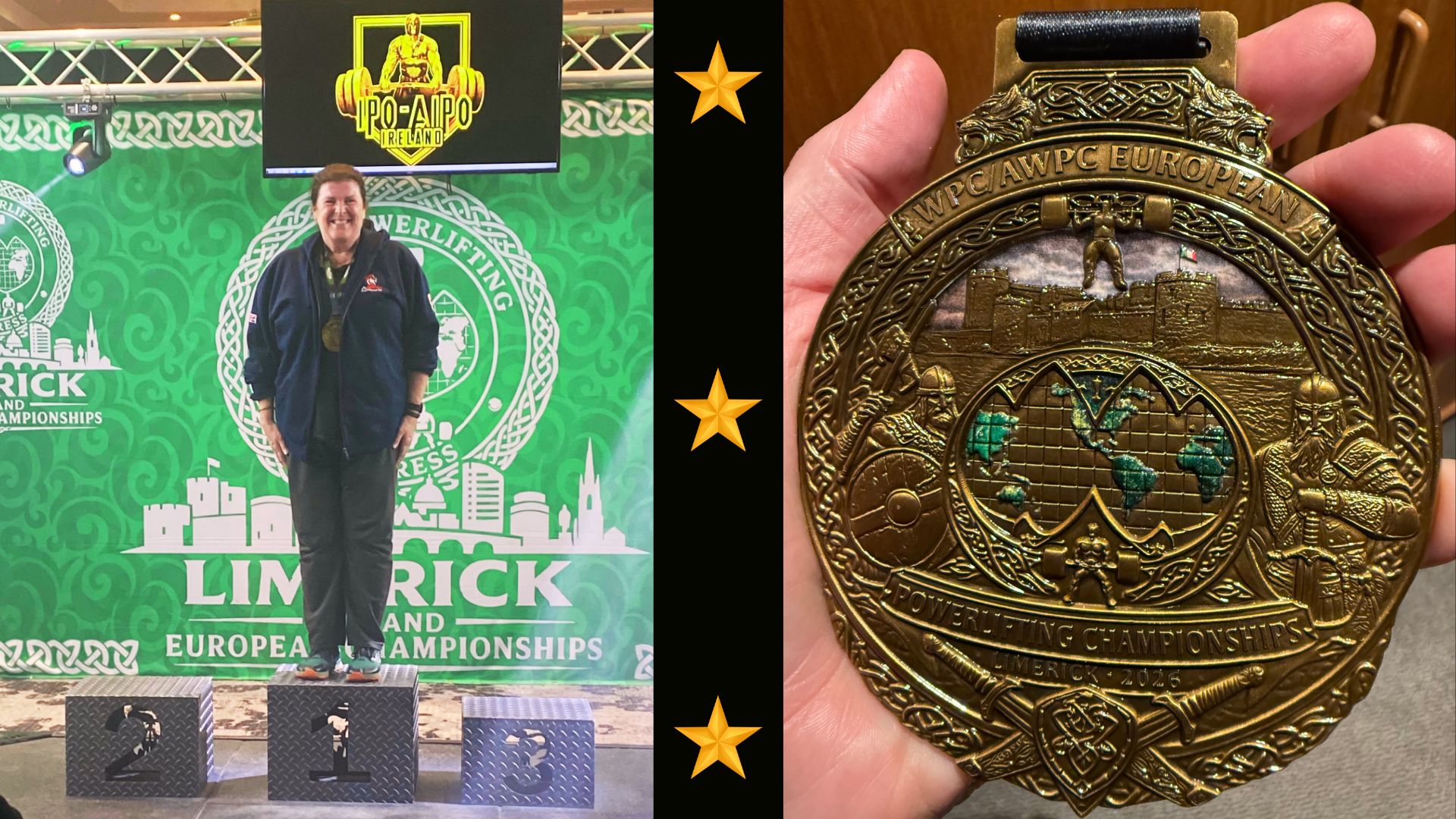
In June, I travelled to Limerick with the GB team and competed in my first international event. After a year of training with my amazing coach, Ian Thistlewood, I was anxious but ready. We had decided on 110 kilos as my opening lift… we would decide the weights for the two following lifts after seeing how well the initial attempt went.
110 kilos. Three white lights.
It was time to go for 120 kilos, which I now knew would be a UK, European and world record for my age and weight class.
120 kilos. Three white lights.
I had been told that I had to remain on the platform after my lift to have my kit checked before they could declare the world record, but when I saw the Azerbaijan judge coming towards me with his arms open wide, I thought he was going to give me a hug! Somewhat embarrassed, he indicated that this was a kit check and not a celebration! Satisfied that I was wearing standard kit, he took my hand, raised my arm in the air and declared it a world record.
One more lift to go. Ian and I had discussed aiming for a personal best of 130 kilos, but I knew that lifting 132.5 kilos would raise my position in the all-time rankings for my age and weight class from 8th to 3rd. We looked at each other for a moment and then agreed, “Go big or go home.”
I walked out onto the platform for the final time and was overwhelmed by the cheers from the spectators. I bent down, grasped the bar, took a deep breath and began to lift. The bar rose slow slowly and, for the briefest of moments, I doubted I could do it. But then the training kicked in. I pushed my hips through and locked out at the top of the lift. The Azerbaijan judge gave me a huge grin and lowered his outstretched arm to indicate that I could put the weight down.
132.5 kilos. Three white lights.
Another kit check (no attempted hug this time!) and once again, he raised my arm and declared it a new world record.
At almost 70 years of age, I had broken the existing world record by 40 kilos and had also become the European champion and a gold medal winner.
How did having a DEXA body scan help with all of this? More than anything else, it gave me reassurance and confidence. By showing me my exact body composition, the scan helped me understand my body and actually see that it was stronger than I realised. It helped me start to feel a sense of pride in my body, as well as a sense of curiosity about how much further it would take me.
For most of my life, I have felt ashamed that my numbers were too big — not the “right” numbers, not “normal” numbers. Armed with the knowledge from my body scans, I am now celebrating all my numbers — my age, my weight and my powerlifting scores — and for the first time, I am proud of them.
For most of my life, I was chasing smaller numbers. Now I’m chasing bigger ones.
Next stop, the British Full Power Championships in July and then maybe… just maybe… the World Championships in September.